
Investable assets are the pool of liquid or near-liquid resources you can deploy in markets to generate returns or appreciate over time. They differ from net worth by excluding illiquid items such as primary residences, collectible art, or personal vehicles. This guide unpacks definitions, categories, calculations, strategic insights, pitfalls, and next-level growth tactics for seasoned investors.
What are investable assets?
Ever wondered which assets fuel your compounding returns? You rely on assets convertible in days or weeks. They exclude illiquid holdings such as your home, collectibles, and vehicles. They deliver transparent pricing and high liquidity.
Which asset categories qualify as investable?
You can sort your holdings into clear buckets:
- Cash and cash equivalents: currency; checking; savings; money market funds.
- Fixed-income instruments: certificates of deposit; government and corporate bonds.
- Equities and funds: individual stocks; ETFs; mutual funds; index funds.
- Retirement vehicles: IRAs; Roth IRAs; legacy 401(k) or 403(b) plans.
- Private and alternative investments: private equity; venture capital; hedge funds; real-asset tokens.
How do you measure liquidity, risk, and return?
Here is a breakdown of asset classes, their liquidity, typical returns, and risk profiles:
| Asset Class | Liquidity | Typical Annual Return | Risk Profile |
| Cash & Money Markets | Days | 0.5–2% | Very Low |
| CDs & Short-Term Bonds | Weeks–Months | 1–4% | Low |
| Stocks & Equity Funds | Instant | 6–12% | Medium–High |
| Corporate & Government Bonds | Days–Weeks | 2–6% | Low–Medium |
| Alternative Private Assets | Months–Years | 8–20% | High |
How do you calculate your investable assets?
Start by listing every liquid and near-liquid holding. Next, subtract any debts tied to those investments. Avoid counting real estate, vehicles, and collectibles. Finally, remove margin loans or personal debts against your portfolio.
What role do investable assets play in your strategy?
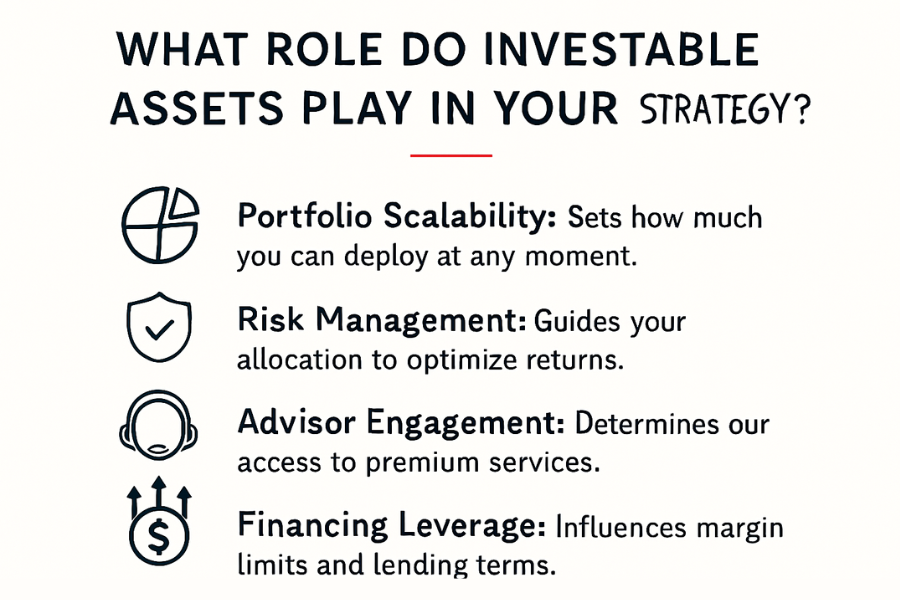
What impact can each factor have on your decisions?
- Portfolio scalability sets how much you can deploy at any moment.
- Risk management guides your allocation to optimize returns.
- Advisor engagement determines your access to premium services.
- Financing leverage influences margin limits and lending terms.
How can you grow your investable assets with advanced tactics?
Why settle for standard growth when you can enhance yield?
- Tax-efficient harvesting: combine Roth conversions with tax-loss harvesting.
- Yield enhancement: use covered calls on core equity positions.
- Selective leverage: apply low-cost margin against liquid ETFs.
- Alternative exposure: allocate to tokenized real estate or DeFi protocols.
- Dynamic rebalancing: automate rules for volatility harvesting.
Which pitfalls hinder your progress and how can you avoid them?
Do you know where hidden risks lurk?
- Overconcentration: cap any single stock or sector at 10–15% of your liquid pool.
- Illiquidity traps: verify lock-up terms before allocating to private funds.
- Hidden fees: audit expense ratios, performance fees, and spreads.
- Emergency reserves: hold 3–6 months of living expenses outside market-linked accounts.
Which tools and practices support ongoing tracking?
How can you stay on top of shifting balances?
- Consolidated dashboards: use Plaid-powered apps for real-time visibility.
- Scheduled reviews: recalculate investable assets monthly or quarterly.
- Scenario planning: run drawdown tests to ensure sufficient liquidity.
- Advisor integrations: sync figures with portals to align on risk tolerance.
What trends will reshape investable assets?
Which themes capture both values and returns?
- ESG ETFs channel values-based growth with alpha potential.
- Fractional real estate tokens democratize property access with liquidity.
- DeFi platforms offer programmable yields on stablecoin pools.
- AI-driven robo-advisors customize mixes via machine-learning signals.
What next-level explorations can refine your approach?
Which tactics can sharpen your competitive edge?
- Integrate Monte Carlo simulations for portfolio stress tests.
- Build fixed-income ladders for predictable cash flows.
- Test hybrid robo/human advisory models for balanced guidance.
- Explore programmable finance protocols for tailored yield.
Additional insights to consider:
- Monitor global yield curves to spot interest-rate shifts.
- Compare margin costs across brokerages for optimal leverage.
- Blend long-short strategies to hedge against market swings.
Final Thought
Keep your liquid assets visible and measurable. Regular checks unlock timely opportunities. Active adjustments protect you from sudden shifts. Solid reserves balance risk and growth. You stay ready for both market swings and new entries.
Which questions answer your key doubts?
Q: How often should you recalculate investable assets?
A: You should update figures at least every quarter. Frequent checks help catch drifts in allocation.
Q: What holdings count as investable assets?
A: You count cash, marketable securities, and retirement balances. Exclude real estate, collectibles, and personal items.
Q: How much cash reserve should you maintain?
A: Hold three to six months of living expenses outside market positions. That buffer shields you during drawdowns.
Q: How do you verify liquidity in private investments?
A: Review lock-up periods, redemption windows, and early-withdrawal penalties. Confirm terms before committing capital.
Q: When should you use margin or leverage?
A: Apply leverage only against highly liquid, low-volatility ETFs. Keep margin under 20% of your total investable assets.
Q: Which fees hide in your portfolio?
A: Look for expense ratios, performance fees, and bid-ask spreads. Low-fee products boost net returns over time.
Q: How can you stress-test your liquidity?
A: Run drawdown scenarios using Monte Carlo tools. Ensure you can meet margin calls and cash needs under extreme markets.
Where comfort meets style, one HomeDwellish at a time