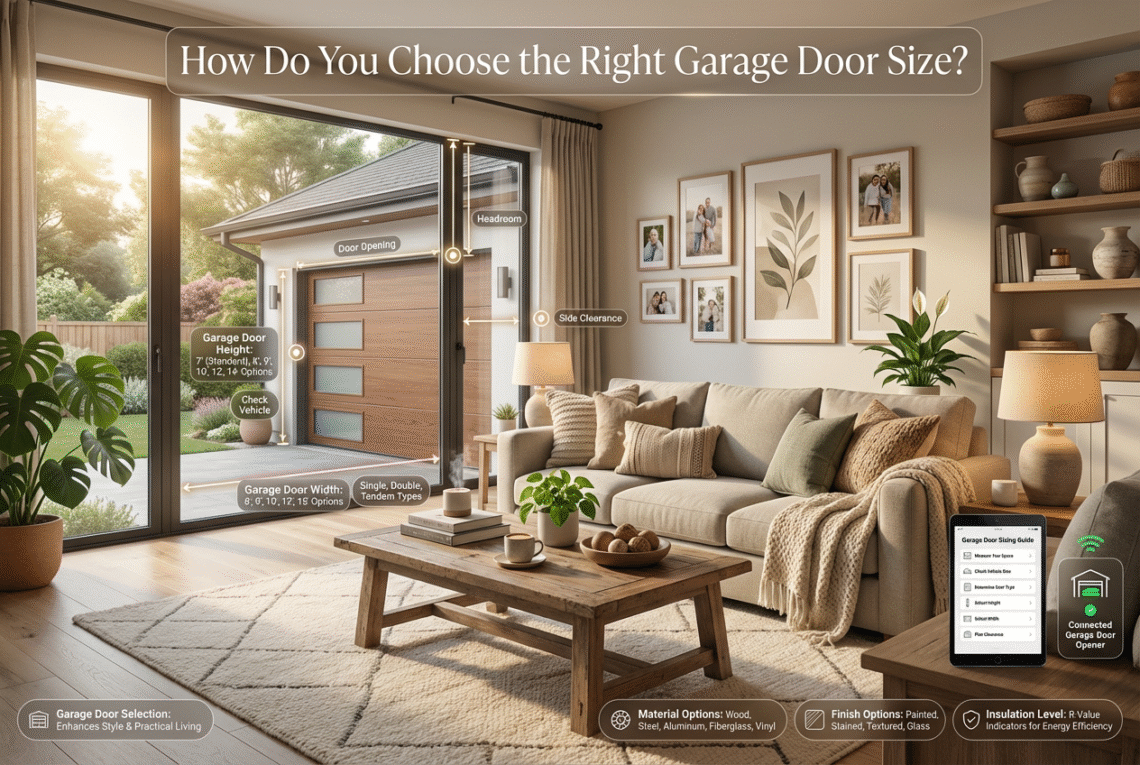
A garage door affects security, insulation, and property value. You need the correct size to ensure smooth operation and long-term performance. The right choice depends on your garage type, available space, and vehicle size.
What Are the Main Garage Door Types and Space Requirements?
Different door types require different clearances. Headroom and track layout determine what will fit.
| Door Type | Headroom Needed | Operation Path | Best For |
| Sectional | ~350 mm | Tracks along ceiling | Large openings, insulation, modern homes |
| Roller | ~450 mm | Rolls into drum above opening | Space-saving, minimal ceiling intrusion |
| Tilt | Varies | Swings outward before lifting | Retro designs, limited track space |
A sectional door suits most modern garages. A roller door works well in low-ceiling spaces. A tilt door fits where track space is limited.
What Are the Standard Garage Door Sizes?
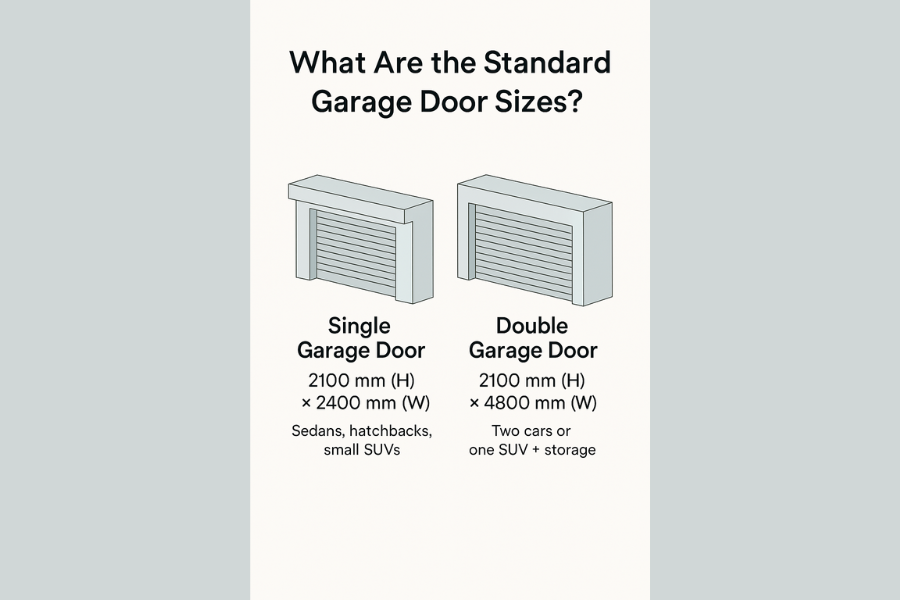
Manufacturers offer made-to-measure options, but standard sizes remain common in Australia and internationally.
Single Garage Doors
- Standard Size: 2100 mm (H) × 2400 mm (W)
- Minimum Internal Garage Size (AU): 3.0 m × 5.4 m
- Vehicle Fit: Sedans, hatchbacks, small SUVs
- Upgrade Tip: Large SUVs or 4×4 vehicles benefit from widths up to 3150 mm.
Double Garage Doors
- Standard Size: 2100 mm (H) × 4800 mm (W)
- Minimum Internal Garage Size (AU): 5.4 m × 5.4 m
- Vehicle Fit: Two standard cars or one large SUV plus storage
- Extended Widths:
- Sectional: up to 6.6 m
- Roller: up to 5.5 m
Extra-Height and Oversized Doors
- For RVs, boats, or tall vans: Heights up to 3.99 m (sectional) or custom-built for 12–16 ft openings
- Commercial Applications: Widths up to 14 ft, thickness up to 3 in for durability and insulation
How Are Sectional Garage Door Panels Configured?
Sectional doors use horizontal panels hinged together. Panel height affects both appearance and track curve.
Common Panel Heights:
- 18″ (457 mm) – More panels, smoother curve
- 21″ (533 mm) – Standard for 7 ft doors (4 panels)
- 24″ (610 mm) – Standard for 8 ft doors (4 panels)
- 28″–32″ (711–813 mm) – Fewer, taller panels for a modern look
Example Configurations:
- 7 ft door: 4 × 21″ panels
- 8 ft door: 4 × 24″ panels or mixed 18″/21″
- 9 ft door: 6 × 18″ panels
How Does Panel Thickness Affect Performance?
Panel thickness impacts insulation, noise control, and strength.
| Type | Construction | Typical Thickness | Best For |
| Non-Insulated Steel | Single-layer | 1⅜″–2″ | Budget, mild climates |
| Polystyrene Insulated | Steel + foam sheet | ~2″ | Moderate insulation |
| Polyurethane Insulated | Steel + injected foam | 1⅜″–2″ | High insulation, rigidity |
| Commercial Grade | Heavy-gauge steel + insulation | 2″–3″ | Industrial, extreme climates |
Polyurethane insulation offers the highest R-value per inch, making it ideal for energy efficiency.
How Do You Measure for a Perfect Fit?
Accurate measurement prevents costly mistakes.
- Measure width inside frame, left to right.
- Measure height from floor to top of opening.
- Check side room: at least 100 mm (single) or 250 mm (double).
- Measure headroom for chosen door type.
- Measure depth from opening to back wall.
- Identify obstructions such as beams or lights.
What Custom Options Are Available?
When standard sizes do not fit, manufacturers can adjust in small increments.
- Custom Widths: 1″–2″ increments
- Custom Heights: Adjust panel count or height in 3″ increments
- Specialty Designs: Windows, woodgrain finishes, wind-rated or bushfire-rated materials
- Oversized Access: Doors up to 6.6 m wide and nearly 4 m tall
Which Door Should You Choose?
- Large vehicles: Sectional with high-lift tracks
- Low ceilings: Roller doors
- Harsh climates: Polyurethane-insulated sectional doors
- Design impact: Fewer, taller panels with architectural finishes
Key Points to Remember
- Measure twice before ordering.
- Insulation improves comfort and efficiency.
- Custom sizing is common and affordable.
- Door type affects available space.
Final Thoughts
A garage door is more than an entry point — it’s a structural, functional, and visual feature that impacts your home’s security, energy efficiency, and curb appeal. The right size ensures smooth operation, protects your vehicles, and maximizes usable space.
Accurate measurements, awareness of headroom and side clearance, and understanding panel configurations will help you choose a door that fits perfectly. Custom sizing is no longer a luxury — it’s a standard option that allows you to match your garage door to your exact needs, whether you’re housing a compact hatchback, a lifted 4×4, or a 12-foot-tall RV.
Investing in the correct size and insulation type now will save you from costly adjustments later. Always work with a professional installer to guarantee precision and long-term performance.
FAQs
Q1: What is the most common garage door size for a single car?
A: In Australia, the standard single garage door size is 2100 mm high × 2400 mm wide. Many homeowners choose widths up to 3150 mm for larger SUVs.
Q2: How tall can a sectional garage door be?
A: Residential sectional doors can reach up to 3.99 m in height. Commercial and custom builds can exceed this for oversized vehicles.
Q3: How much headroom do I need for a garage door?
A: Sectional doors require about 350 mm of headroom. Roller doors need around 450 mm. Tilt doors vary depending on the design.
Q4: Can I get a garage door in a non-standard size?
A: Yes. Manufacturers can adjust widths in 1–2 inch increments and heights in 3-inch increments. This is common for unique openings or architectural designs.
Q5: What’s the difference between polystyrene and polyurethane insulation?
A: Polystyrene is a foam sheet bonded to the panel, offering moderate insulation. Polyurethane is injected foam that expands inside the panel, providing higher thermal efficiency and rigidity.
Q6: How do I measure my garage for a new door?
A: Measure width, height, side room, headroom, and depth. Check for obstructions like beams or lights. A professional can verify measurements before ordering.
Q7: Which door type is best for low ceilings?
A: Roller doors are ideal for low ceilings because they roll into a compact drum above the opening, leaving more ceiling space free.
Q8: Do larger vehicles require special garage doors?
A: Yes. RVs, boats, and tall vans often need doors 3–4 m high and wider than standard double doors. Sectional doors with high-lift tracks are a popular choice.Find inspiration, ideas, and guides to elevate your living space at HomeDwellish.