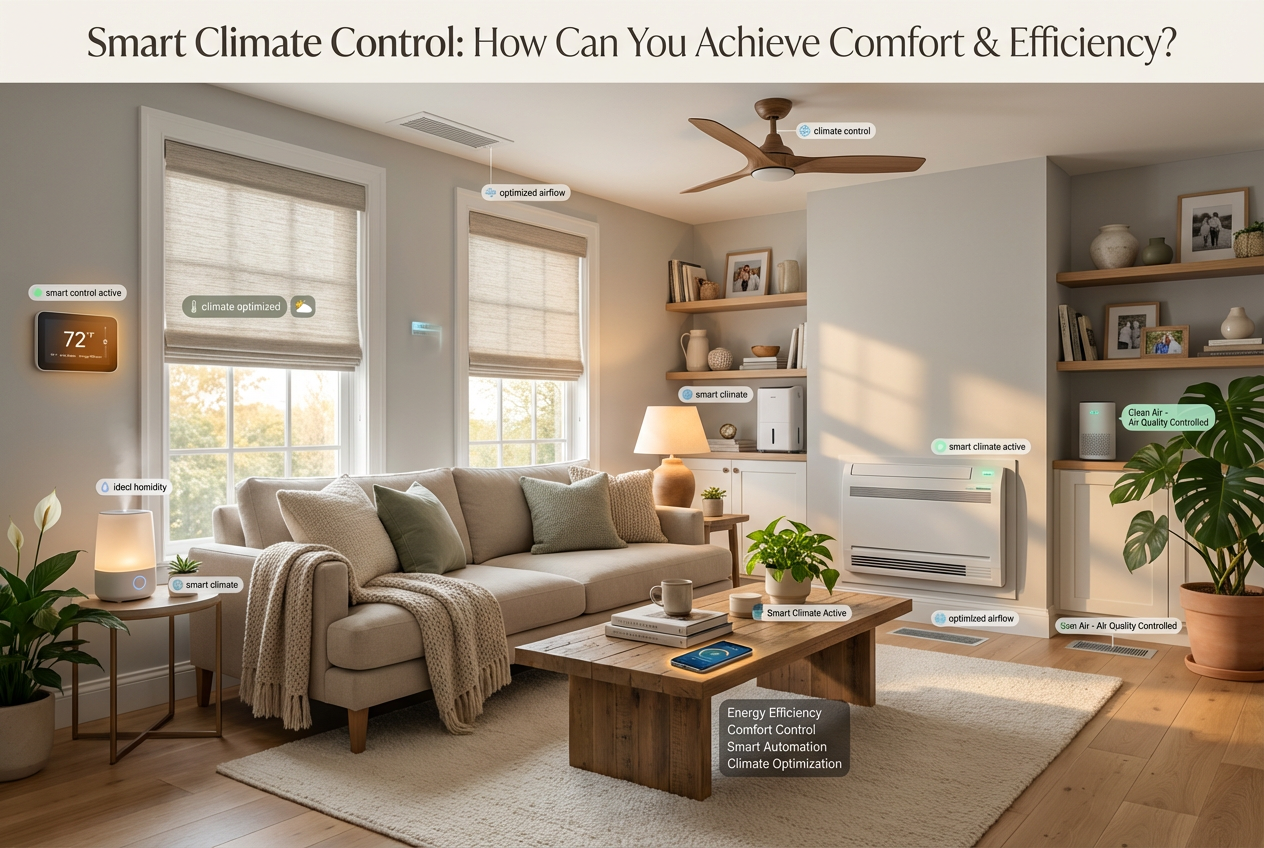
Smart Climate Control
You aim for precise comfort and lower bills. A smart climate control system blends sensors, AI, and HVAC into one adaptive network. It responds to your habits and local weather in real time.
What Components Deliver True Comfort?
A smart thermostat forms the core of your system. Multiple sensors feed it accurate data. Temperature and humidity sensors track exact readings in each room. Occupancy sensors pause heating or cooling in unused spaces. CO₂ and air‑quality sensors trigger fresh‑air intake when thresholds rise above safe levels.
Research from Fujitsu shows multi‑sensor setups cut energy use by up to 25% annually. Industry data confirms predictive ventilation can raise indoor air quality scores by 30%.
How Do Algorithms Learn Your Routine?
Machine learning gives you hands‑free control. Algorithms record your daily schedule and temperature changes. Geofencing shifts the system to “away” mode when your phone leaves the property. Forecast‑aware controls pre‑heat or pre‑cool before weather changes.
Roombanker reports predictive adjustments can reduce peak‑hour energy demand by 15%. Systems then smooth HVAC load curves and prevent costly utility spikes.
How Can You Manage the System Remotely?
A dedicated app gives you full control from any phone or tablet. You see real‑time status updates and energy reports. Voice assistants from Google, Amazon, or Apple respond to spoken commands.
Energy tracking in the app highlights waste patterns. You can spot an idle fan or an over‑cooled bedroom in seconds.
How Does Zoned Control Amplify Savings?
Zoning divides your home into separate comfort areas. You heat or cool only the spaces in use. ASHRAE guidelines show zoned systems can deliver up to 20% savings over whole‑home schedules. Each zone holds its own setpoint for precise comfort.
How Do You Integrate Renewables and Demand Response?
Pair your system with solar panels or wind generation. Program the controller to use excess solar output first. Join utility demand‑response programs to earn credits for reducing load during peak‑price hours.
Field data shows homes in demand‑response plans can cut peak billing by 40%.
How Should You Plan and Install for Long‑Term Success?
A needs assessment sets the foundation. You measure home size, climate, insulation, and daily habits. Choose components that share the same protocol such as Wi‑Fi, Zigbee, or KNX. Confirm compatibility with your furnace or AC.
Leave 30 cm service loops at each device. Mount thermostats at 120 cm in a neutral location. Keep 50 mm clearance for airflow. Label all wires at both ends.
How Do Real Installations Prove the Value?
Hotels with room‑level automation report HVAC cost cuts of 35%. Offices with smart scheduling earn LEED points. Homeowners praise consistent morning warmth and cool evenings without manual input.
What Quick Checklist Ensures Peak Performance?
Choose a smart thermostat with an open API.
Add temperature, humidity, occupancy, and air‑quality sensors.
Verify device compatibility on one network.
Plan zone layouts with dedicated controllers.
Pre‑wire with 25 mm conduits and pull strings.
Set service loops and label every cable.
Install surge protection and a small UPS for controllers.
Integrate renewable sources and join demand‑response programs.
Final Thought
A smart climate control system gives you more than comfort. It delivers measurable savings, cleaner air, and a home that responds to your life. The right mix of sensors, algorithms, and zoning turns every room into its own comfort zone. Data from trusted sources proves the gains in energy efficiency and indoor air quality. A well‑planned installation ensures those gains last for years.
FAQs
Q: How much can a smart climate control system save annually?
Industry research shows savings of 20% to 25% on energy use when multi‑sensor setups and zoning are in place.
Q: Which sensors are essential for optimal performance?
Temperature, humidity, occupancy, CO₂, and air‑quality sensors form the core for accurate control.
Q: Can the system work with existing HVAC equipment?
Compatibility depends on the communication protocol and control interface. A needs assessment confirms the match.
Q: How does geofencing improve efficiency?
The system shifts to an energy‑saving mode when your phone leaves the property, reducing unnecessary heating or cooling.
Q: What role does predictive control play?
Forecast‑aware algorithms pre‑adjust temperatures before weather changes, cutting peak‑hour demand by up to 15%.
Q: How does renewable integration affect costs?
Using excess solar or wind output first reduces grid reliance. Demand‑response participation can lower peak billing by 40%.
Q: Is remote control secure?
Modern apps use encrypted connections and multi‑factor authentication to protect access.
Q: What installation practices ensure long‑term reliability?
Service loops, proper mounting heights, airflow clearance, and labeled wiring keep the system efficient and easy to maintain.
“Experience smart living and stylish spaces at homedwellish.”
About the Author